What is pickleball? The complete beginner's guide (2026)
Pickleball is the fastest-growing sport in Australia, and it's deliberately one of the easiest to pick up — most people are playing real points within their first half hour. Here's everything a complete beginner needs to understand the game before stepping on court.
Updated June 2026
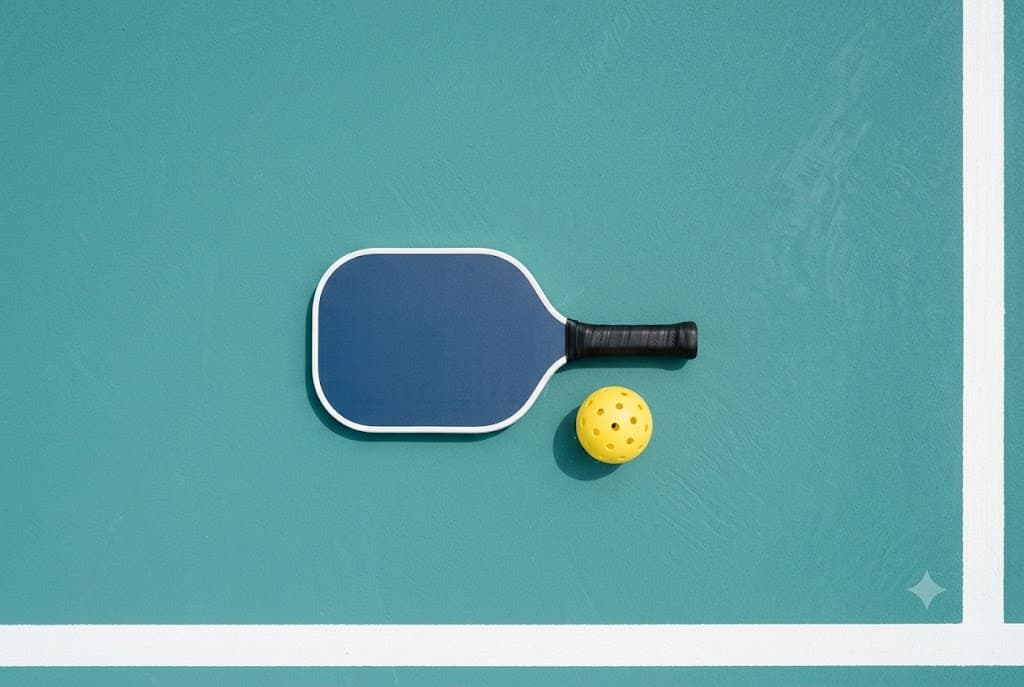
Pickleball is a paddle sport that blends elements of tennis, badminton and table tennis. It's played on a court the size of a badminton court with a solid paddle and a lightweight plastic ball full of holes. You can play singles (one against one) or doubles (two against two), though doubles is by far the most common, especially socially.
The appeal is simple: the court is small, the ball moves slower than a tennis ball, and the rules reward placement and touch over raw power. That combination means a complete beginner and a seasoned player can have a genuinely fun game together — which is a big part of why the sport has spread so quickly across Australian clubs, parks and rec centres.
The court
A pickleball court is 6.1 metres wide and 13.4 metres long (20 by 44 feet) — the same dimensions for both singles and doubles. The net sits a touch lower than a tennis net: 86 cm at the posts and 91 cm at the sidelines.
The defining feature is the non-volley zone, universally known as 'the kitchen'. It's the 2.1-metre (7-foot) strip on each side of the net. Understanding the kitchen is the single thing that turns a confused beginner into someone who looks like they know what they're doing.
The kitchen rule, explained simply
You cannot hit the ball out of the air (a 'volley') while you're standing in the kitchen or touching its line. You can step into the kitchen any time to play a ball that has already bounced — you just can't volley from in there.
Why it exists: without the kitchen, tall players would simply stand at the net and smash everything. The rule forces players back, which creates the slow, tactical exchanges at the net — called 'dinking' — that give pickleball its character. New players break this rule constantly in their first session; a coach gets you past it in one.
How a point is played
The serve is underhand and hit diagonally across the court, landing past the opponent's kitchen. Then comes the rule that catches everyone out: the two-bounce rule.
- The serve must bounce once before the receiving team can return it.
- The return must then bounce once before the serving team can hit it.
- After those two bounces, either side may volley (hit the ball before it bounces) — except from inside the kitchen.
Scoring
Most social and club games are played to 11 points, win by two. Tournaments sometimes play to 15 or 21.
In traditional scoring, only the serving side can win a point — if the receiving side wins the rally, they don't score, they just win the serve. In doubles the score is called as three numbers: your team's score, the other team's score, and whether you're the first or second server (for example, '4–2–1'). It sounds fiddly written down, but it clicks within a game or two. Some newer competition formats use 'rally scoring', where every rally scores a point regardless of who served.
The gear you actually need
Pickleball is cheap to start, which is another reason it's grown so fast. You need three things, and for your first session you probably need to buy none of them.
- A paddle — solid-faced, smaller than a tennis racquet. Clubs almost always have loaners, so borrow before you buy.
- A ball — a perforated plastic ball. Indoor balls are softer with larger holes; outdoor balls are harder with smaller holes to handle wind. The venue supplies these.
- Court shoes — this is the one thing worth getting right early. Pickleball involves quick lateral movement, and running shoes don't support side-to-side motion. Proper court shoes (tennis or pickleball-specific) prevent the most common beginner injuries.
Skill ratings
As you get more serious you'll hear about ratings. Australia uses DUPR (the Dynamic Universal Pickleball Rating), the same system adopted by Pickleball Australia for sanctioned events. It rates players on a scale that rises with results, so you can find games against people at your level. As a beginner you don't need to worry about it — but it's useful to know the word when you hear it at a club.
Why it's booming in Australia
Pickleball rewards beginners faster than almost any other sport: the learning curve is gentle, it's intensely social, and it's low-impact enough to play across a huge age range. Australian membership has been roughly doubling year on year, courts are being built and converted across the country, and the sport has its biggest spotlight yet on the horizon with Brisbane hosting the 2032 Olympics.
The practical upshot for a new player: there's almost certainly a beginner session near you, and the community is unusually welcoming to people turning up for the first time.